Are you wasting money on shipping costs by paying for empty space? What is LTL shipping, and why should it matter to your business? Less than truckload (LTL) shipping offers a smart solution for businesses with freight that weighs between 150 and 15,000 pounds but doesn't require an entire trailer.
Instead of waiting to accumulate enough products to fill a truck or paying for unused space, LTL freight shipping allows you to share trailer capacity with other shippers. This approach significantly improves efficiency by consolidating multiple shipments into one trailer. Additionally, it creates substantial cost savings as you only pay for the space you actually use.
LTL shipping also offers environmental benefits by reducing the number of trucks on the road, ultimately lowering emissions and shrinking your company's carbon footprint. Without proper knowledge of how this system works, however, you might be missing out on these advantages for your business.
What is LTL shipping, and how does it work?
LTL shipping stands for "Less-than-Truckload" shipping, a freight transportation method where multiple shipments from different businesses share space on a single truck. Essentially, it's designed for shipments that don't require an entire trailer yet are too large for standard parcel services.
The defining characteristic of LTL freight is its size and weight range—typically between 150 and 15,000 pounds. Most carriers consider shipments of one to six pallets as LTL, though some accept up to ten pallets. These shipments generally occupy less than 12 linear feet of trailer space.
What makes LTL shipping unique is its operational structure. LTL carriers utilize a "hub-and-spoke" network where local terminals (spokes) connect to central distribution centers (hubs). Your shipment follows this journey:
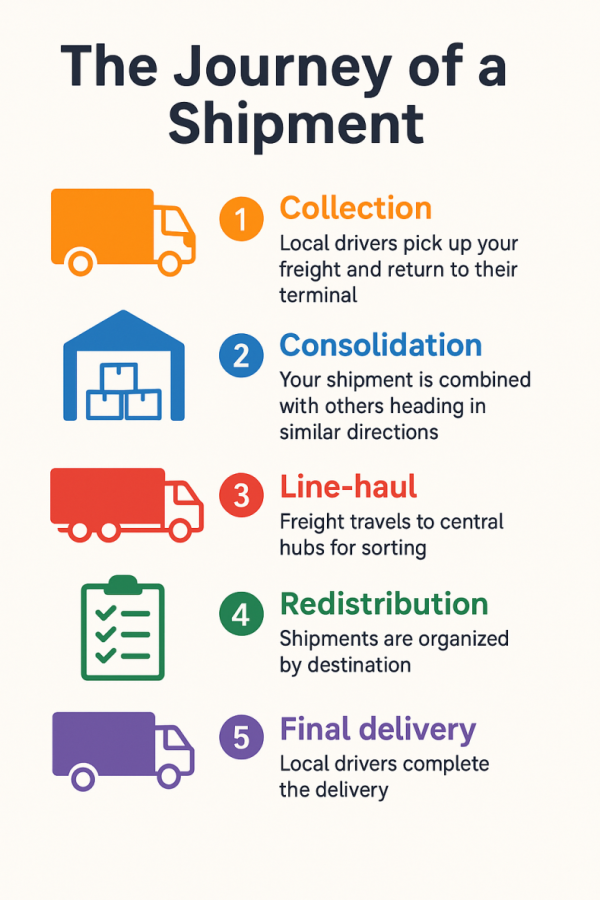
During this process, your shipment may be loaded and unloaded multiple times. Furthermore, transit times for LTL are longer than for full truckload since shipments don't travel directly to their destinations.
Unlike parcel services (under 150 pounds) or full truckload shipping (entire trailer), LTL offers a middle-ground solution for businesses with mid-sized shipping needs.
Key benefits and challenges of LTL freight
The financial advantages of LTL shipping come with operational trade-offs that smart business owners must evaluate. Understanding both sides helps you make informed shipping decisions.
1. Cost Efficiency
Cost efficiency stands as the primary benefit of LTL shipping. You only pay for the space your freight occupies rather than an entire trailer. This shared transportation approach can yield significant savings—in one analysis, a shipment using just 12% of trailer space cost $500 via LTL compared to $2,100 for a full truckload, representing a 76% savings.
2. Environmental Benefits
Environmental benefits emerge naturally from consolidating multiple shipments. This approach reduces the number of trucks needed, consequently lowering carbon emissions. Many environmentally conscious consumers now prefer businesses that use sustainable shipping methods.
Despite these advantages, LTL shipping presents several challenges.
3. Transit Reliability
Transit reliability remains a concern as LTL shipments typically experience longer, less predictable delivery times. The hub-and-spoke model means your freight will move through several legs and terminals before reaching its destination.
4. Increased Damage Risk
Increased damage risk represents another significant challenge. LTL shipments may change hands 5-6 times during transit, with freight being handled more frequently than in full truckload shipping. This increased handling results in damage rates of 1-3% for LTL compared to 0.5-1% for full truckload shipments.
Best practices to optimize your LTL shipping
Maximizing efficiency in LTL shipping requires strategic planning and attention to detail. Selecting the right carrier makes all the difference in your shipping success.
When choosing an LTL provider, prioritize companies with proven records for on-time pickup and delivery, as this directly impacts customer satisfaction. Moreover, look for carriers that emphasize product safety, especially since damaged products represent the most common customer complaint. Carrier responsiveness and billing accuracy should likewise factor into your decision-making process.
Transportation Management Systems (TMS) dramatically improve LTL operations. These platforms provide route optimization, carrier comparison, and automated notifications that save both time and money. According to research, TMS software can streamline hours of manual work while reducing input errors. Furthermore, these systems enable 24-hour shipment tracking, allowing you to provide customers with real-time updates.
Precise measurement prevents costly surprises. Always measure freight after packaging, including pallets and wrapping. Use accurate tools like tape measures instead of estimating. Proper packaging is equally important—LTL shipments may be unloaded and reloaded multiple times. Accordingly, use standard wooden pallets that can hold up to 2,800 pounds and stack to a maximum height of 84 inches. Finally, secure your shipment with stretch wrap, overlapping each layer by at least 50%.
Planning ahead helps avoid accessorial charges that can quickly accumulate. Notify carriers upfront about any special handling requirements.
Conclusion
LTL shipping is a cost-effective solution for businesses with freight too large for parcels but not enough for a full truckload. By sharing trailer space with other shippers, you pay only for the space you use, but you must consider longer transit times and potential damage risks. Choosing the right carrier, using a Transportation Management System, and ensuring proper packaging are key to maximizing benefits and avoiding issues. When managed well, LTL shipping reduces costs, improves efficiency, and supports sustainability, making it a smart choice for many mid-sized freight needs.