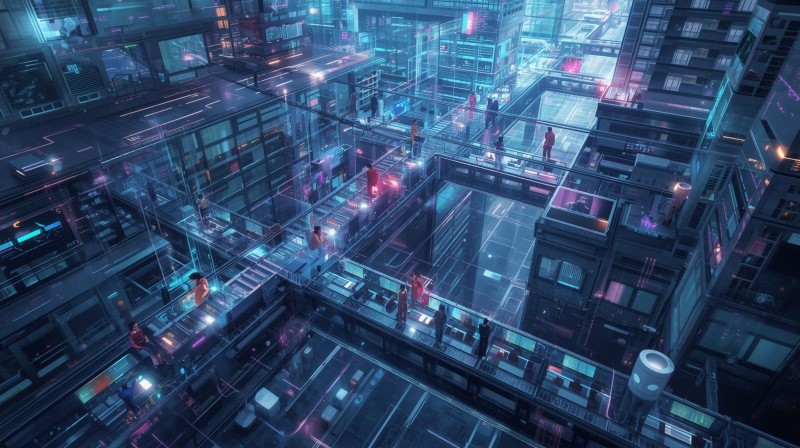
Digital twins represent one of the technologies that are both the most revolutionary and, at the same time, the least used in the fast-paced technological world. Having been limited to aerospace and heavy manufacturing, the technology behind digital twins is now introduced to the fields of healthcare and smart cities. Digital twins are now playing a major role in predictive analytics and real-time decision-making as businesses also focus on efficiency, sustainability, and innovation.
What is a Digital Twin?
A digital twin is a computerized duplicate of a real-world entity, system or process. It applies real-time data and simulations to reflect the work of its physical counterpart in terms of performance, state and behavior. This enables the businesses to view, examine and even forecast the results without touching the actual physical object.
Imagine it as a living, breathing simulator of your factory, car engine, or even a whole building--constantly updated with sensor and IoT-based data.
Why Digital Twins Matter
Industry 4.0 has increased the need to have smart and connected systems. Digital twins have unlimited value in this environment by:
- Reducing Downtime: Digital-twin-powered predictive maintenance aids companies in preventing the occurrence of issues before they lead to expensive shutdowns.
- Enhancing Product Design: Engineers have an opportunity to simulate the performance of new products in reality conditions before they make physical prototypes.
- Improving the Decision-Making Process: Live data can help make evidence-based decisions that will lead to greater efficiency and safety.
Real-World Applications
- Healthcare: Human organs are being generated as digital counterparts in order to test the reactions of drugs, or arrange surgeries, and tailor treatment plans as never before.
- Smart Cities: Urban planners simulate traffic flow, utility utilisation, and disaster recovery through digital twins of cities.
- Manufacture: Factories rely on digital copies of their manufacturing lines to streamline the production, energy usage, and quality.
- Energy Industry: Wind farms and power plants have built digital copies of its infrastructure to forecast performance and optimize power distribution.
Challenges to Adoption
Digital twins have their challenges, in spite of their advantages:
- Data Security: The more data you generate and simulate the more risk of cyberattacks.
- Complex Integration: The integration of digital twins systems and current infrastructure may be a technical challenge.
- High Start-up Costs: State of the art sensors, data platforms, and expertise are expensive to implement at the outset.
Nonetheless, the barriers are decreasing because of AI, cloud computing and IoT in their rapid evolution, and so the digital twin technology becomes more affordable to small and medium-sized companies.
Conclusion
Digital twins will become the foundation of innovation as industries become more intelligent, automated and predictive. When you are a technological expert, scientist, or author and there is something to be said about the upcoming technologies such as this, your voice needs some platform.
Get an opportunity to write about and share your ideas, experiences and thought leadership on new and emerging issues by becoming an author at WSJ. We embrace contributions that are motivating, educational and creative.
Would you like to share your expertise with more people? Write for us technology and enter the future of thought leadership in tech